
Service · VAPT
VAPT services - exploit-grade, standards-aligned.
Vulnerability assessment and penetration testing on infra, web apps, APIs, mobile, and cloud. CERT-In-aligned methodology; OWASP + NIST 800-115 + PTES across the rest of the stack.
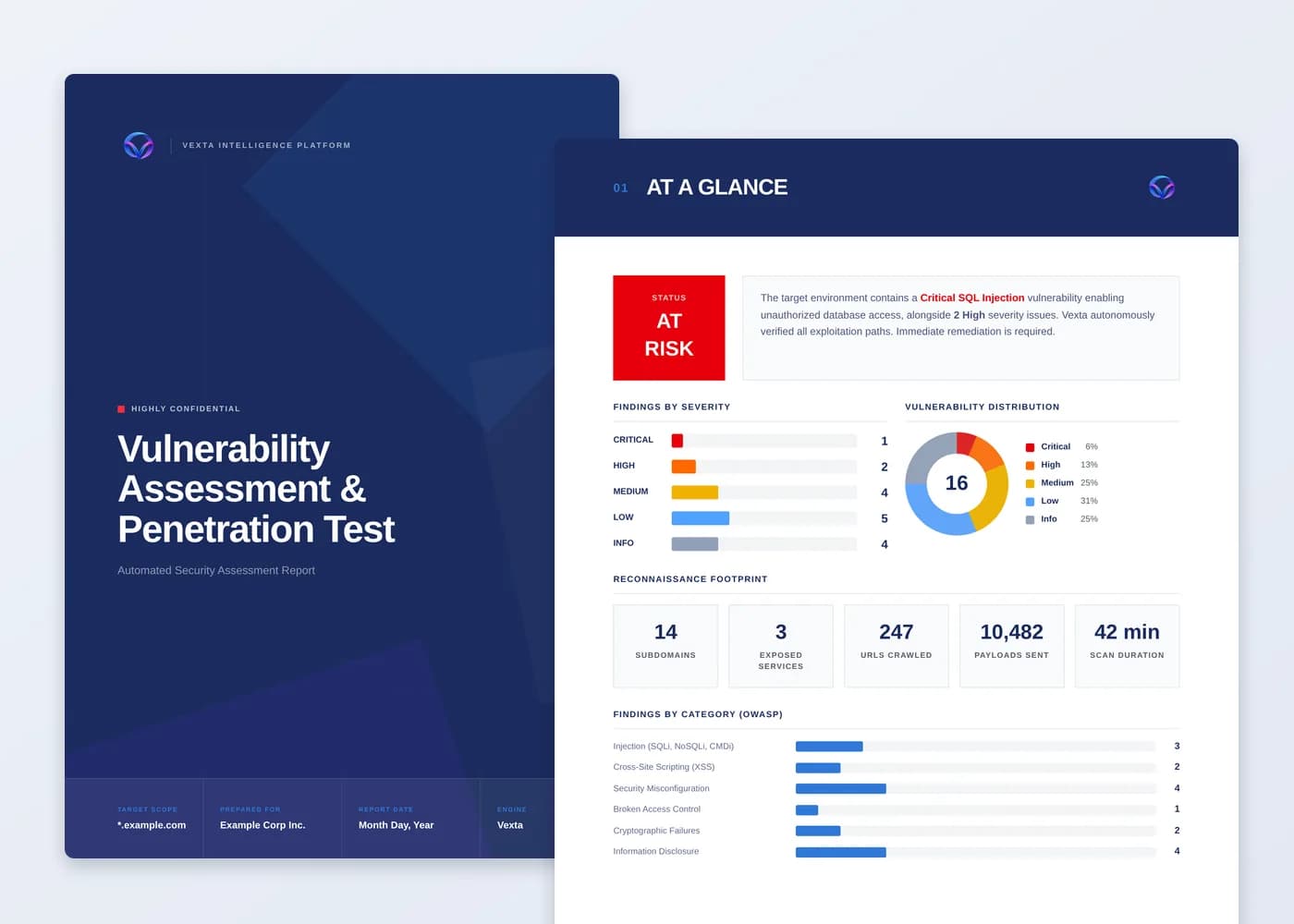
What we test
What our VAPT services cover.
Every engagement combines automated scanning (Vexta + commercial tools) with manual exploitation by a senior pentester.
External network
Internet-facing assets: web servers, mail, VPN, exposed services. CVE + misconfig + exposed credentials.
Internal network
Authenticated assessment of the LAN: lateral movement, privilege escalation, AD/identity weaknesses.
Web applications
OWASP Top 10 + business-logic + auth/authz. Manual testing, not just scanner output.
APIs (REST + GraphQL)
Auth, authz, rate limits, injection, data exposure. OpenAPI-spec-driven or proxy-captured.
Mobile (iOS + Android)
Static + dynamic analysis. Reverse-engineering. Cert pinning, secure storage, IPC.
Cloud (AWS / GCP / Azure)
IAM, public buckets, exposed secrets, misconfigured services. Mapped to CIS benchmarks.
Assessment or penetration test
VAPT is two different jobs sold under one acronym.
Vulnerability assessment is breadth: cover the whole estate, find everything known, prioritise it. Penetration testing is depth: take a small number of targets and find what a determined attacker would do with them, including the things no scanner will ever surface. Most buyers are quoted one and are expecting the other, and the gap only becomes obvious when the report arrives.
- Assessment answers "what is exposed across everything we own". It is the right purchase when you have never looked, when you need a baseline, or when compliance asks for regular scanning.
- Penetration testing answers "what can somebody actually do to us". It is the right purchase before a launch, after a big architectural change, or when a customer contract specifies it.
- Business-logic flaws, chained privilege escalation, authorisation bypasses and race conditions do not appear in scanner output at all. Only manual testing finds them, and they are usually the findings that matter most.
- Our reports label which findings came from automation and which from manual testing, so you can see exactly what you paid for rather than taking the total on trust.
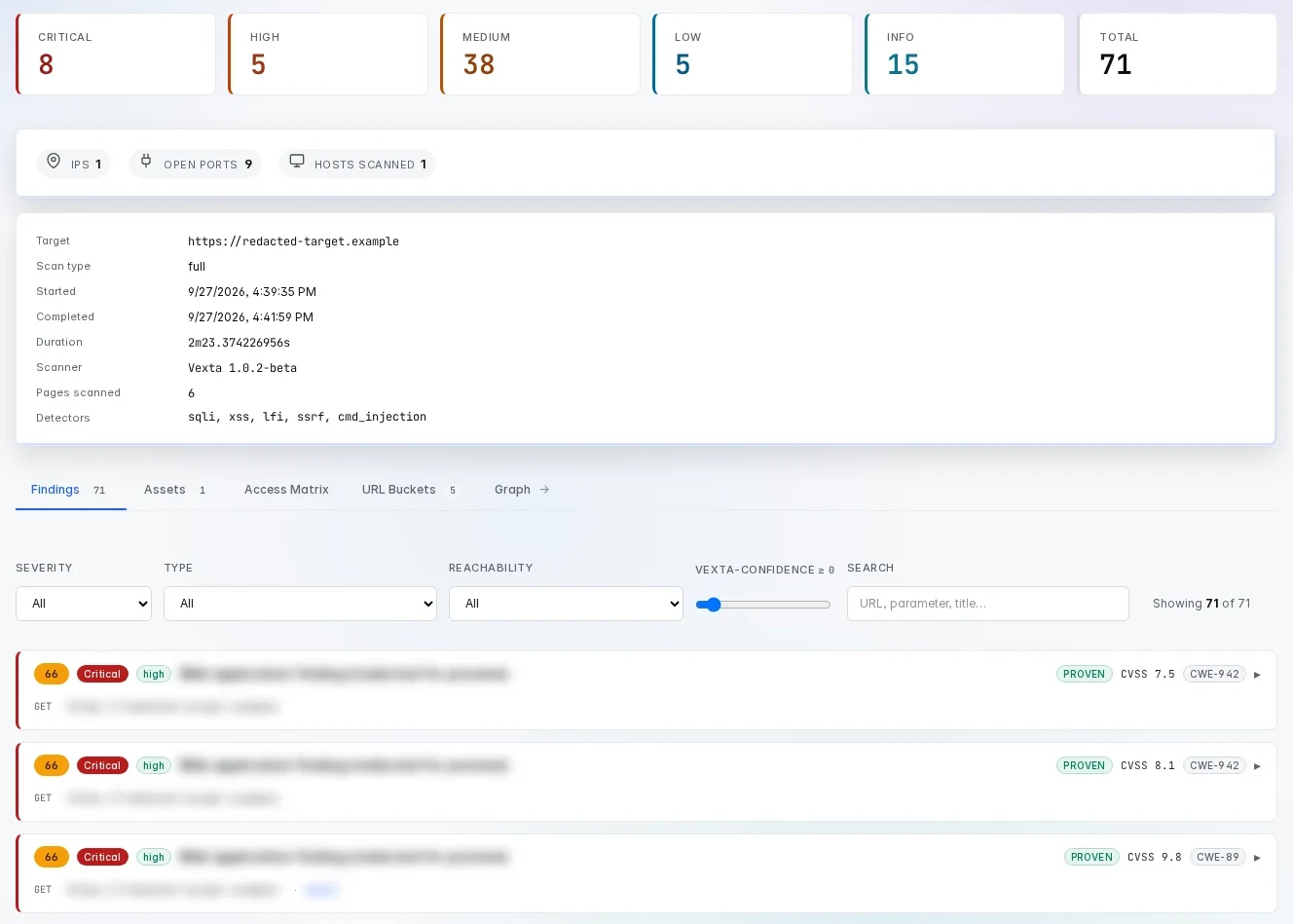
What is in the report
The deliverable, in detail.
You can read the whole thing before you buy - the full sample report is published, not gated behind a form.
Executive summary
One page for whoever funds the remediation. Business risk in plain English, no CVSS soup, no jargon that needs a translator in the room.
Findings ranked by exploitability
Ordered by what an attacker could realistically do against your specific setup, not by raw CVSS. A critical on an unreachable asset outranks nothing.
Reproduction steps for every finding
Enough detail for your engineers to confirm it themselves. A finding your team cannot reproduce is a finding they will not fix, and rightly so.
Remediation tied to your stack
The specific fix, a complexity estimate, and sequencing so the highest-risk items are also the ones you can ship first.
Evidence for auditors
Mapped to the standard you are being measured against - CERT-In, OWASP, NIST SP 800-115, PCI-DSS or SOC 2 - so the report is usable in an audit rather than only internally.
A walkthrough, not just a PDF
We talk your engineers through the findings live. Questions get answered by the person who found the issue, not by a support address.
What you walk away with
Standards we follow
We don't invent methodology. We follow what auditors actually accept.
Scoping it properly
What we need from you before we can price it.
The five answers that turn a vague enquiry into a fixed number. If you do not have them, the scoping call exists to work them out with you.
The asset list
Domains, IP ranges, applications, APIs and cloud accounts you want in scope - and just as importantly, anything that must stay out. Third-party SaaS you do not own cannot be tested without the provider’s permission, and we will tell you where that line falls.
Authenticated or not
Unauthenticated testing shows what a stranger sees. Authenticated testing, with real accounts at each privilege level, is where authorisation bypasses and privilege escalation actually surface. The second finds far more and costs more; most estates need both eventually.
What a bad day looks like
Which system, if it were breached, would genuinely hurt - the payments path, the customer database, the admin console. Testing is finite, so it should be weighted toward what you actually cannot afford to lose rather than spread evenly.
Who is driving the deadline
A customer security review, an auditor, an investor, a regulator, or nobody yet. Each produces a different report emphasis, and knowing it up front prevents the classic outcome where the testing was fine but the deliverable does not satisfy whoever asked for it.
Environment: production or staging
Production gives the truest result. Staging is safer but only useful if it genuinely mirrors production - a staging environment with different data, different config or a different WAF will produce findings that do not transfer. We will say which we recommend and why.
What we cannot do
The limits, stated up front.
Four things a pentest is not, which are usually discovered halfway through an engagement with somebody less direct about it.
It is not a certificate
A pentest report is evidence, not an attestation. If your customer needs ISO 27001 or SOC 2, the report supports the programme but the certificate comes from an accredited body or a CPA firm you retain separately.
It is not a guarantee
Testing is time-boxed and bounded by the agreed scope. A clean report means nothing exploitable was found in that surface, in that window, at that skill level. Any firm selling you certainty about the absence of vulnerabilities is selling you something that does not exist.
It does not fix anything by itself
The report changes nothing until somebody ships the remediation. That is why the re-test is included and why we will ask, during scoping, who is going to do the fixing. If the answer is nobody, the testing is premature.
It is not a substitute for the basics
If MFA is not enforced, patching is ad hoc and nobody reviews access, a pentest will tell you that expensively. Those are cheaper to fix than to discover. We will say so rather than write a long report about a short problem.
How an engagement runs
4 phases. Each with a clear deliverable.
You stay informed every step. No mystery-box pentest.
Scope + rules
In-scope assets, out-of-scope guardrails, escalation contacts, NDAs. Fixed price for the engagement.
Test
1-3 weeks of active testing. Daily check-ins. Critical findings flagged immediately, not at the end.
Report + walkthrough
Auditor-ready PDF + executive summary. Live walkthrough of every finding with engineering.
Re-test (included)
After your team ships fixes, we re-test for free. Same engineer. No context loss.
After the report
The part most engagements skip.
A pentest report changes nothing on its own. The findings only matter once somebody ships the fix, and that is where most engagements quietly fail: the report is delivered, the invoice is paid, the criticals sit in a backlog behind feature work, and twelve months later the next test finds the same issues. The re-test is included for that reason, and it is the only part of the process that actually moves your risk rather than describing it.
- Every finding carries a fix, a complexity estimate and a plain-English reason it matters, so whoever prioritises the backlog can weigh it against feature work honestly.
- Your engineers get a live walkthrough with the person who found the issue. Questions get answered in the room rather than through a support address a week later.
- We can do the remediation ourselves where you want that, or hand it to your team and stay available for questions. Both are normal; the choice affects the price, not the report.
- The re-test covers the same scope with the same engineer at no additional cost. What was fixed is confirmed fixed, and what was not is still on the list rather than quietly forgotten.
- If the same class of finding keeps recurring, that is a process problem rather than a bug, and the retest report will say so. Testing the same estate repeatedly and never asking why is how firms bill for years without improving anything.
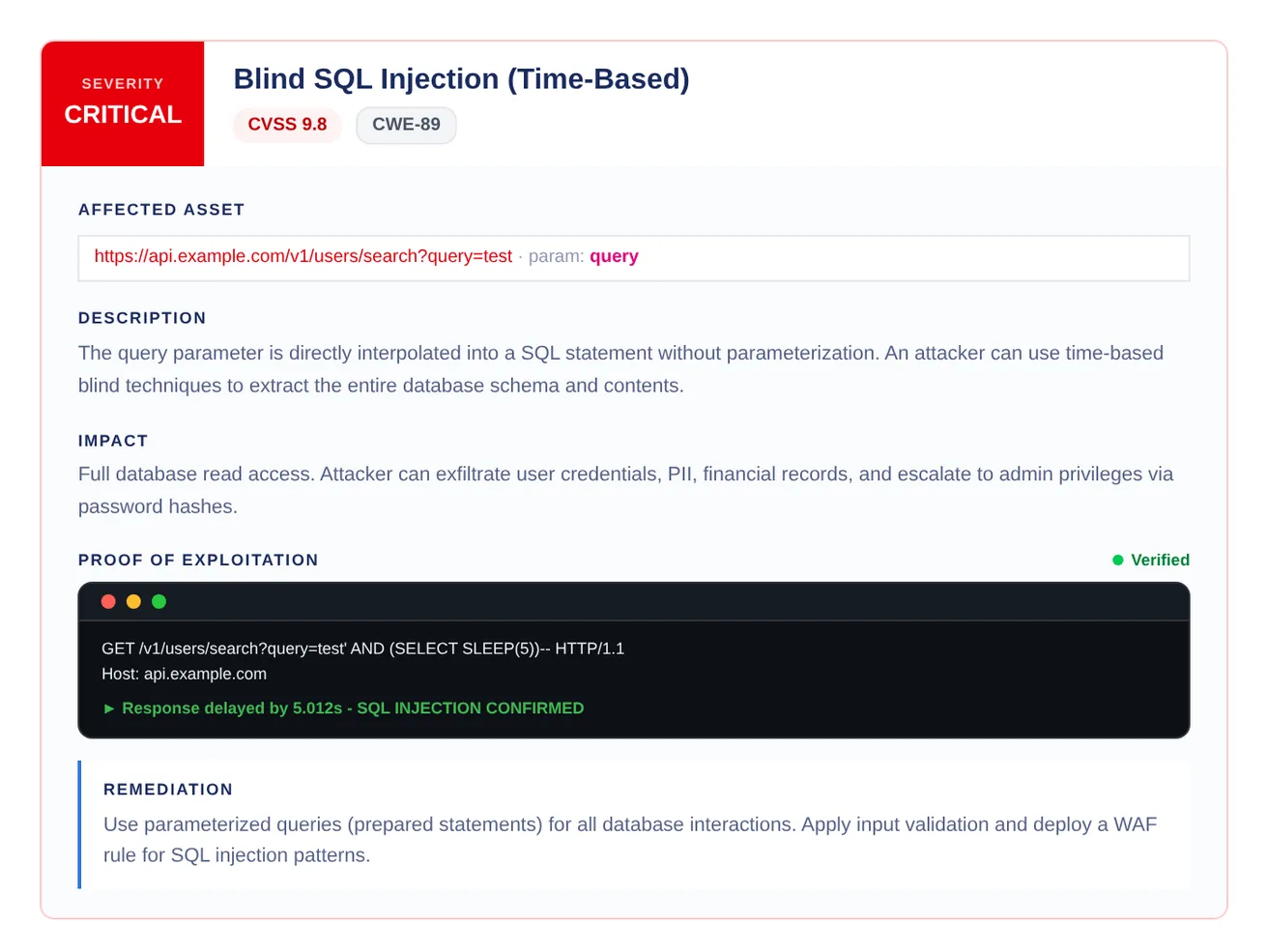
VAPT FAQ
What does a pentest cost?
What actually drives the price?
What is the difference between a vulnerability assessment and a penetration test?
Are you CERT-In empanelled?
Whose tools do you use?
Can I see a report before I buy?
How long does an engagement take?
Will testing take our systems down?
What happens if you find something critical mid-engagement?
Is the re-test really included?
Do you do ongoing attack-surface management?
Same methodology for US and European clients?
Next steps
Pick the next step.
Pick whichever fits how far along you are - we will meet you there.
Run a free website scan
Point it at a website you own and get a findings summary - no sales call needed.
Get a quote
Four short fields below. A fixed quote back within one business day.
Book a call
30 minutes, no deck, no pre-qualification. Bring the actual problem.
Try Vexta free
Run the same scanning engine yourself, self-hosted, on your own schedule.
Get a quote
Four fields. A fixed quote within one business day.
No sales call required to get a number. Tell us what triggered this and when you need it by, and we will come back with a fixed price for VAPT.
Pentest your stack before someone else does.
Scoping call this week. Findings the next. Re-test included.